Cox Communications · 2018 to 2021
Rebuilding the Cox Business resolve journey
I owned the highest-stakes journey in Cox Business, from the first call for help to the moment it is fixed.
- Company
- Cox Communications
- My role
- CX Journey Lead
- Scope
- Cross-functional transformation
- Years
- 2018 to 2021
- Reading time
- 3 minutes
Resolve is where the relationship is kept or lost. Cox Business serves hospitals, schools, banks, and small businesses whose operations depend on reliable connectivity. When something breaks, they do not want a ticket number. They want it fixed. My mandate was one sentence:
"Own this journey end to end, from the first 'Help!' to the final 'Fixed.'"
The situation
More than 60% of Cox Business customers hit a resolve issue every year, so this was the journey most of them used.
Picture a small accounting firm in peak tax season. The internet goes down. The owner calls, gets transferred between three agents, waits hours for updates, and finally learns a technician can come tomorrow. They are not thinking about network architecture. They are thinking that their business is losing money and they cannot reach help.
That was a pattern, not a one-off.
What was broken
Three problems kept showing up:
- Fragmented journeys. Sales, support, billing, and field service each ran their own processes and had their own definition of done. One customer told us, "I feel like I am reintroducing myself every time I call."
- Portfolio complexity. Cox Business sold an enterprise-grade portfolio, but the support experience was not built for that complexity. One agent kept a cheat sheet under the keyboard to get through internal systems.
- A reactive model. "Call us when it breaks" does not work for a hospital. As one director put it, "When we call you, it's not a complaint. It's a crisis."
How I approached it
I ran this as a journey-led transformation, not a process patch.
1. Diagnose deeply
I interviewed customers across industries, ran agent listening sessions, and shadowed support and field teams. Then I mapped the existing journey end to end and scored it for friction, latency, and root cause.
2. Align the organization
Workshops with support, billing, engineering, sales, and field operations produced shared definitions of resolution, SLAs, ownership, and hand-offs.
3. Define the future state
We set five principles for the new experience:
- Clarity: always know status, next step, and ETA
- Speed: fewer hand-offs
- Empathy: acknowledge the impact on the customer
- Proactive prevention: monitor and notify before customers call
- One Cox: a single experience across teams
4. Pilot, test, learn
We piloted with real Cox Business customers and iterated on resolution time, customer anxiety, agent effort, escalation volume, and feedback.
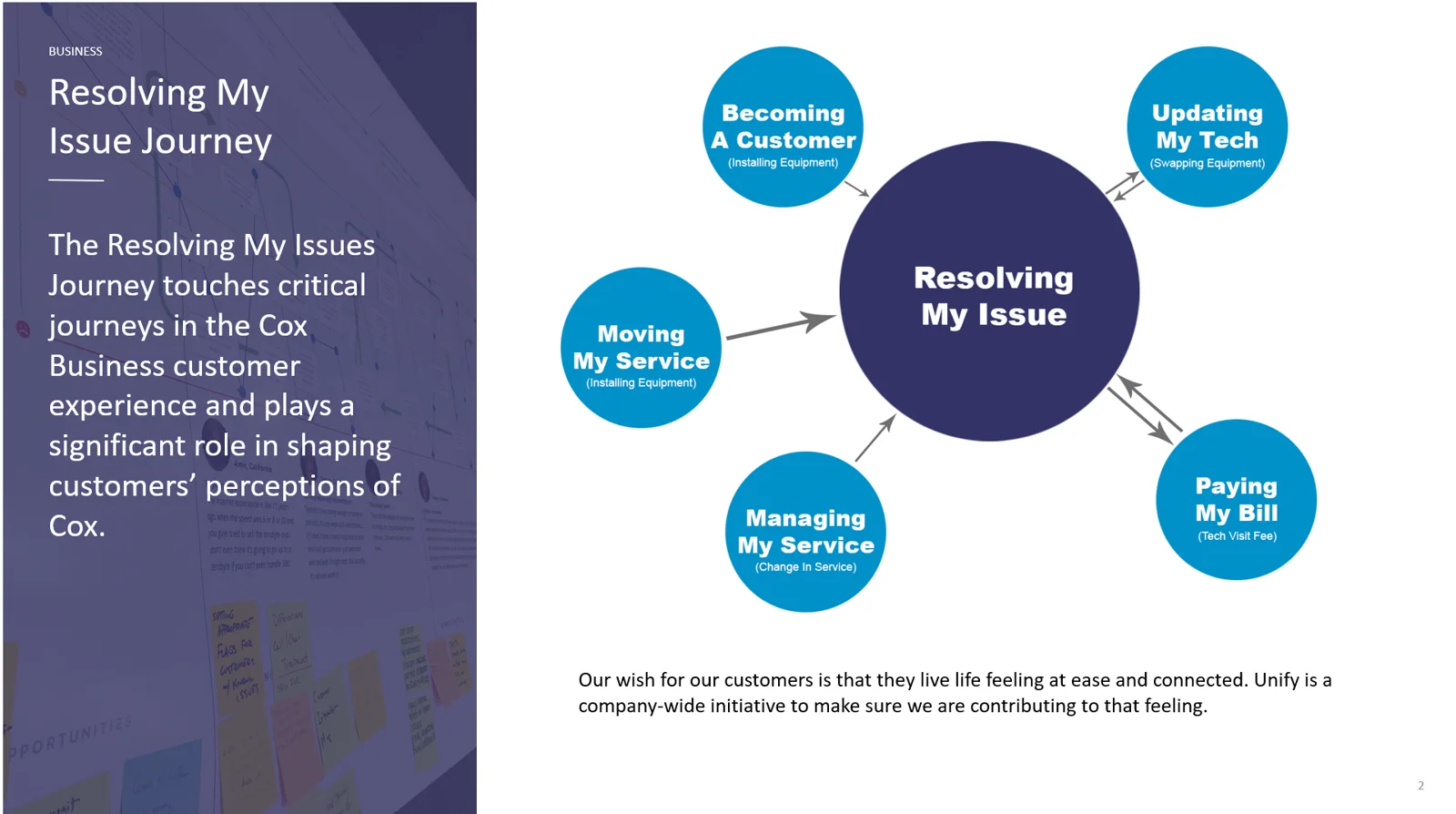
The future state
The redesigned journey rested on three pillars.
Diagnose quickly, resolve intelligently. Automated service health checks, real-time outage detection, and configuration insights moved the experience from "tell us what's wrong" to "we already see it."
One team, one journey. A single case owner, unified case history, shared tools, and clear SLAs replaced the relay race between departments.
Confidence through transparency. Clear status updates, predictable ETAs, technician tracking, and follow-ups rebuilt trust one step at a time.
What changed
The transformation was long-tail and cross-functional. Early results showed shorter resolution times, fewer hand-offs per case, fewer escalations, and lower agent effort, along with higher customer trust and better alignment across Cox teams.
What I'd do differently
I would bring field operations into the design work earlier. We aligned them, but the technicians' reality shaped the journey more than any workshop did.